Day 15 marked the official missed-the-payment-entirely line. Sure, it was due on Day 0, but Day 15 marked the end of the grace period and the first appearance of a late fee. It was preceded by a phone call that my payment was almost late, and followed by an email that my payment was officially late.
Part of this economic adventure has been realizing that I don't want to be with a bank anymore. I don't want my money sitting with a company whose whole intention is to make money off me. I don't like that my bank had to take a bailout, that they consider adding fees to necessities like debit cards, that their executives get ridiculous bonuses while their customers suffer, and that they're a rather heartless business. I'd rather pull my money out of the corporate goliaths and bring it local. I have joined my husband's credit union and am working on moving all the bills over to that account. Everything from my paycheck to the power bill will start going through his/our credit union. We had not joined accounts since getting married yet, so this was a perfect opportunity.
Knowing that I don't want my money with banks, I also knew I didn't want my new credit-boosting credit card to be with a bank or major corporation. So I joined a second local credit union. I learned that I can't join without some money being in their accounts, but I only had to have five bucks in an account to get the credit card. I opened a basic savings account, no bells or whistles, and applied for a credit card.
They did a soft-check of my credit score to open the savings account, and a hard check to open my credit card. My credit score actually did not budge at all despite the hard check and a new higher credit limit. Not yet at least. I was approved for their lowest interest rate on their only credit card, and the teller said she'd never seen anyone actually qualify for that. :) While it's good to have great credit and reap those rewards, I'll soon be like the rest of her customers and won't look so squeaky clean. That's why I'm doing this now - before my score drops for other reasons and to use that time dropped to recover simultaneously. That hard credit check will stay on my credit history for two years, but since it appears to have had no effect, no big deal.
I decided that since my credit score didn't move in the slightest, it's not worth getting a second new credit card. Maybe if I'd seen it jump a few points for having doubled my credit limit, it'd be worth considering tripling my credit limit. The hassle of a fourth institution (2 credit unions, 1 bank, +1 new) handling my money isn't worth it – not to mention a fourth username/password pair! If I was still going to get a third card, it'd be with the third credit union I qualify for through my job. I believe I've maxed out potential credit unions at that point though.
Once I get all my bills sorted and have verified that they've all transitioned to the credit union for a month or two, I'll close the bank account and move that cash to the new savings account. It'll be wholly in my name, so on the small chance that Cory runs off to Canada with some cute indie hipster chick and takes all our newly-joint money, I'll still have something for me. Moving all my money will also - and more practically - mean the mortgage company (who is luckily different than my bank) will have no access to my money and will not know where it is. I had been previously worried that they'd pull money out of my account despite me no longer authorizing it, but since they haven't yet, I'm not worried anymore. That would be literally stealing, and while I have very little respect for my mortgage company, I do think they're above stealing (money at least, not houses).
Cory and I will also start actually using our credit cards. Till now, we've only been using debit, seeing no need to insert more people in to the process and having no need to carry a balance ever. Now though, I've gotten some tips on when it really is better to use credit: (1) any time the card leaves your sight, (2) you don't have your purchase already in hand, or (3) at particularly vulnerable locations. From now on, we'll use our credit cards at (1) any restaurant that takes your card away from the table, (2) any time we order something online, and (3) at all gas stations. This way, we'll have protection from unauthorized purchases (1&3) and protection from incorrect/damaged products (2). We'll aim to stay below 10% of our credit limit on each card per month, to maximize the credit score benefits of using the credit card.
In the next couple weeks, I imagine the phone calls and emails will be more prevalent. Perhaps paper mail will show up. And I'll find out if Day 30 brings a drop to my credit score, or the first phone call + 30 days, or the late fee + 30 days, or some random date that they finally get around to reporting me.
Now that I’ve firmly settled in to this foreclosure plan,
and am working towards it, my mind apparently needed something else to obsess
about. It settled on… Credit!
Knowing that my credit score will be taking a tumble very
shortly, I decided to start investigating how to keep it moderately afloat
during the next seven years as best I could. There’s already room to improve my
credit score, so my next plan of action is to use up as much of that room as I
can.
The place to start my investigation was at
AnnualCreditReport.com to get my credit report. There are plenty of other
websites that all offer to give you your credit report and/or credit score for
free, but this is the one that doesn’t make you sign up for emails, or scams,
or charge a hidden monthly fee. You can do this once per year per credit
reporting agency. I know that I will be very interested in watching my credit
report over the next year, so I decided to only get my TransUnion report. This
means I can check another agency in 4 months, the third in 8 months, and be
back to TransUnion this time next year. I even set a reminder on my calendar at
work to tell me when to check them.
I didn’t see how to get my credit score for free from
TransUnion, just how to see it for “free*” which doesn’t count. I decided I
didn’t actually care what my score was because I could verify that everything
was accurate on my report and because how they do their calculations is beyond
me anyway.
Instead, I spent a bunch of time learning what I could from
ClarkHoward.com. He recommended CreditKarma.com to evaluate my credit report.
(I know, I’m linking a million websites this time. Sorry!) Credit Karma uses
your TransUnion report only, which isn’t ideal, but is better than nothing, and
I luckily had my TransUnion report already in hand, meaning I could verify
their accuracy.
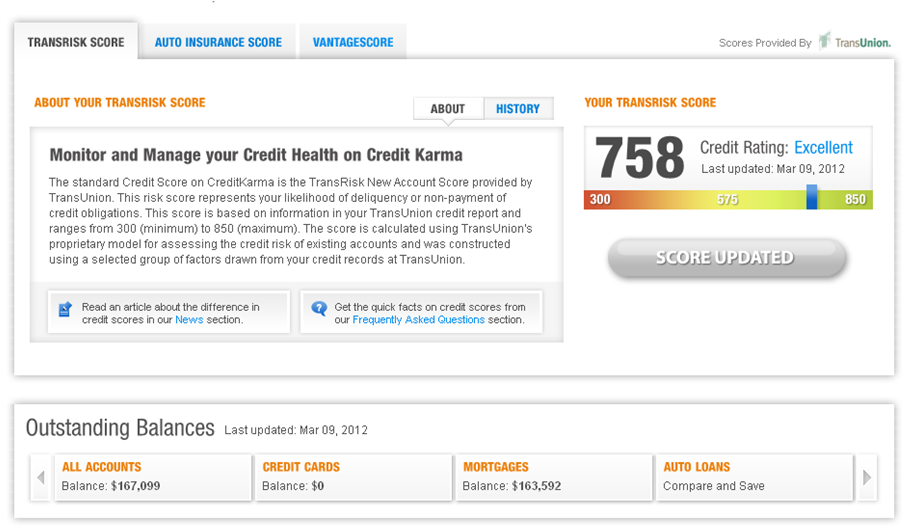
Here’s what Credit Karma had for me:
I’ve got a pretty darn good credit score, but not perfect.
It can see my two loans: $164k for the
condo, and $3500 left in student loans. I did have to give them my email
address and access to my credit report to get this information. And I’m sure
I’ll be getting more spam email soon. They’ve also got a TON of ads once you’re
in there, trying to “save” you money.
The best part of this website, though, and what I really
wanted to use it for, was the “credit report card”. Here’s mine:
And the best part:
It looks like I’m doing great paying on time, having no hard
credit inquires lately, and having no derogatory marks. All of these will be
ruined soon. I’m going to stop paying my mortgage on time, and that will be
reported as soon as Day 30. That will lead to foreclosure, a definite
derogatory mark. Lastly, in order to boost up my other grades, I plan to open
at least one new credit card so I will have at least one new hard inquiry.
Since all of these will be dropping, it’d be wise to try to
improve my other areas so that my score doesn’t have to fall so far. I might as
well take all the hits together while I’ve got lots of time to recover.
This report card has taught me:
1)I
have to start using the one credit card I do have to improve my “C – N/A”
rating in the usage category. Clark Howard says 10% or less is optimum. So
perhaps I’ll switch one monthly bill over to the credit card I already have and
pay it off each month. As long as I use it once every six months minimum, it’ll
stay “active” and helpful to me.
2)I
can’t help the average age of my current accounts, or the C rating. In fact,
it’s only going to get worse by opening up a new line of credit. But, that one
will fix itself in time.
3)I
need to open more accounts! This is not a good idea for everyone. But, my 10
whole accounts is somehow freakishly low. I thought 10 was kind of a lot. The
only way I even got that many was through my student loans and mortgage being
sold a few times each. I should try to get new cards sooner than later, while
I’m better able to qualify for a high credit limit (only got a few weeks left
on that!), and then actually use them.
Thus, my task ahead is clear. Very soon, I will be applying
for one or two more credit cards (more than that seems like too many to juggle
however great my score would be or however many awesome rewards they promise),
and creating some system to use them regularly to bolster my low grades.
Credit Karma had one more gem for me. They’ve got a “Credit
Simulator.” It looks at your credit report then estimates what might happen to
your credit score if you do some things differently.
For example, I asked it what would happen to my credit score
if I open up these two new credit cards with say $20,000 of credit between
them, and have two necessary hard checks against my report. It says my score
will go from 758 to 760. Up is good! Sure, it’s only two points, but it’s up.
It’ll increase my credit limit (thus reducing my usage percentage), increase my
number of credit lines, but also increase the number of checks against the
report. Despite that downer, it nets positive.
Next I asked it what happens to my score if one of my lines
of credit (mortgage) goes to 90 days past due – its longest option.It spits out: 758 to 650. Ouch. Oddly, just
adding a foreclosure to my “public record” only dropped my score to 710. And
very oddly, having one account 90 days past due AND having a foreclosure on the
record only left me with a credit score of 683 -higher than the 90 days only.
Something’s not quite right with this system. That doesn’t
seem reasonable at all. Other places report more like 150 points lost for
having a foreclosure. And the higher your score beforehand, the more you lose.
Now that I’ve got this handy tool though, I’ll be able to
actually to track what does really happen to my credit score. I plan to check
Credit Karma regularly and make a lovely Excel chart of its results. (I like
charts.) Once the bank starts reporting something, and my score/report start
moving, I’ll post it for you to see.
Day 0! We've taken the big first step today! Steering the ship towards Scylla, not Charybdis.
Here's what the next year or more of our lives will be measured by:
March 2 Day 1 Missed payment Loan officially in default April 1 Day 31 (or any date later) Notice of Default from the bank May not be less than 30 days from "initial contact", where they try to get me to pay May 1 Day 61 (or actual date of "Day 31" + at least 30 days) Notice of Trustee Sale posted on our door May not be less than 90 days before the date of the sale Aug 3 Day 151 (or actual date of "Day 61" + between 90 and 210 days) Foreclosure sale, must be a Friday Bank must publish sale in a local paper once 4-5 weeks before sale and once 1-2 weeks before sale Aug 23 Day 171 (or actual date of "Day 151" + exactly 20 days) We have to be out of the condo, and ownership transfers Foreclosure officially done!
However, CNN Money reported today that 1 in 4 homes sold in 2011 was in some state of foreclosure. And that short sales were averaging 308 days to close last year; foreclosures averaged considerably longer. Our foreclosure will definitely take longer than the 171 minimum above. The lawyer estimated a minimum of 8 months, and said he's got a client sitting at 22 months now.
Hello everyone. Welcome to our brand new blog. My husband (Cory) and I (Jane) plan to keep this updated as we progress through our foreclosure.
Foreclosure seems to be something that nobody wants to talk about, and that nobody wants YOU to talk about. Especially the mortgage companies. But with the influx of foreclosures going on the last few years, and the rampant mismanagement of those foreclosures, maybe it's not such a terrible thing to talk about anymore.
So I'll be talking about mine. I'd like to start with a few disclaimers. First, any and all information in this blog may not be applicable to you. Everything that I'll be undergoing is subject only to Washington State law. Your state has entirely different laws for mortgages and foreclosures and you should not expect them to be the same as mine. Second, I'm not doing anything wrong. There is nothing wrong with a foreclosure or talking about foreclosure. Lenders just don't like them, and they don't like people talking about them. So I'd appreciate if you helped me keep this under wraps. I'm aware it's public, being on the internet and all, but as long as nothing can tie this blog to my name or address, my foreclosure will go a lot more smoothly. Lastly, I don't intend this to be instructional or terribly informative. I'm pretty much entirely creating it to help my friends and family worry about me less, and know that I'm alright throughout the process.
Let's start!
I'd like to call today "Day Negative One." Tomorrow, March 1st, will be the day that my mortgage payment is due and will be the first time, EVER, that I've missed a payment. On anything. I've prided myself on being incredibly responsible with my money. I'm proud of my spotless credit score. I'm proud of not using credit. I'm proud of having savings that keep me comfortable. I've worked for all of those things in my life and have been lucky enough to be able to keep them.
Tomorrow will be a big day for me. Missing a payment with the full intention of never paying it. Come March 2nd, "Day 1", I will be on my way towards a foreclosure, even if the bank doesn't know it yet. I'll keep tabs on what happens when, what I'm expecting next, and how it's going.
Before I get there though, I should explain how I got here.
In the last couple months, I really started realizing how far underwater my sad little condo was. Based on the recently sold units in my complex, I'm at least $80,000 underwater. It suddenly felt like a huge black hole that would swallow up all my money if I didn't escape from it. Staying here was never a long-term goal. I bought the condo in 2008, shortly after prices hard started dropping. I thought, "Hey! Great! Prices are down. Mortgage costs the same as rent. I should buy!" And it was an alright decision at the time. I had no way of knowing that prices would continue to sink forever. I thought my 3% down payment, plus a few years of paying the mortgage would leave me not much worse for the wear. I'm now approaching four years since that decision and I want out. I'm 80,000 worse for the wear and counting.
This black hole of a condo kept creeping up on me. It kept me up at nights - I wasn't sleeping well. It would depress me at the most random times. It would make me tear up just talking about the house I would've liked to have had with Cory but that we'd never be able to get. Our options looked like this:
1) Sell the condo and pay off the balance of the loan. We'd have had to sink thousands of dollars in to the place sprucing it up, improving, repairing, and crossing our fingers hoping that ours sells before the neighbors'. After that, we'd have to scrape together the balance of the loan out of our savings and retirement accounts. We'd end up broke, damaging our retirement, exhausted, and potentially stuck trying to move a house that nobody wanted.
2) Grin and bear it. Live here till the cows come home. We'd have to stay in our sad little condo, with the tiny kitchen, with rickety steps, with grumpy HOA board members, with loud neighbors, with a parking lot outside our bedroom window, with the interstate beyond that, and with no joy left in being here, feeling trapped. There would still be 26 years on my mortgage, and far too many of those would be required to be spent in the condo before the price came up enough and the principal on the loan came down enough, that we could afford to leave without causing Option 1. According to an internet amortization calculator, and assuming a 1% yearly increase in value of the condo (that's a little optimistic), it'd take me until 2029 to actually have a few dollars of equity. 2031 if the value doesn't increase at all. Far longer than I want to live here, at any rate.
3) Contact the bank and negotiate relief on the mortgage. That would mean a short sale, or a deed-in-lieu-of-foreclosure, or a refinance on the loan terms. For the short sale of deed-in-lieu, we would have to talk to the bank. Having not missed any payments yet, they would have no reason to give us any relief. They'd just say that obviously we can afford to pay (or else we'd have missed some payments already), so pay. If they were willing to consider relief, we'd have to show them our finances. Only my name is on the loan, and I've been paying the mortgage out of a bank account solely in my name, but because we're in a "common property state" all the payments I've made, all the money I've made, are half my husband's, and vice versa. Showing the bank our finances would be the worst thing we could do, because they'd be able to see that we do have those savings, and they'd either refuse us relief, or they'd take the savings. Neither is a good option. The last option, refinancing, does not require that we show the bank our finances. But it would only be beneficial if we were intending to stay in the condo long enough to realize any value. Refinancing costs money up front, so it'd take a couple years to earn back that cost in the lower interest rate we'd get. And then many more years to buy the loan down to near the diminishing value of the condo.
That leaves:
4) Default. Just stop paying. Do nothing and let it all happen. Suffer the consequences and get the albatross off my neck. It seemed the only remaining option to me. I don't want to be here. I don't want to lose our combined life savings because of one bad decision. I don't have the ability to sell the condo and continue paying down the mortgage because it's not allowed per law. Mortgage loans have to have a property as collateral and two people cannot have a single property as collateral, especially when only one of them would actually own it. Every other investment, you're able to cut ties with it when it's no longer making you money.
I decided foreclosure was the route for me. A strategic default was my best chance at protecting my financial future and to sleep through the night. But Cory wasn't convinced. I had done all this internet research on my own. Generally late at night when he was asleep and finances were keeping me awake. So he was still hours of research behind me, and trying to catch up. He still held out hope that one of the options was better.
I tried getting as much help as I could from non-internet sources. I tried talking to two mortgage companies (neither was the one I actually had my mortgage with), a tax adviser, and emailed some lawyers. In all cases, I either got radio silence, or "go talk to a lawyer." So, finally, Cory and I decided that we had to go sit down with a real lawyer, pay the guy, and get his advice. It'd be the only way we'd both get up to speed, and that we'd feel informed enough to make such a huge decision.
Last week, Day -7, we met with a bona fide real estate lawyer, paid him a flat rate to talk to us and answer all our questions. We'll even be able to send him copies of all the documents that show up at our door, he reviewed our entire mortgage contract, and he wants to keep tabs on how we're doing.
We talked for an hour. The conclusion was to default. 100% just do it. And do it soon. Specifically because of our savings, we should have no communications with the bank. They cannot get our financial information in any way other than asking us for it, or suing us. They'd have no reason to sue us as there's no current indication that they'd get any value out of it. It's "unheard of" for lenders to sue over a sad little 2 bedroom condo in our area. Worst case, if they do decide to sue (that really would be the worst case scenario now), he'll be available to represent us and won't let it come to a judgment against us. In that very very worst case, it'd mean the bank can take the condo (that's not so bad) and then take the balance of the loan in any way they can - like our cars, savings, etc.
The lawyer did warn us that my credit score will be ruined for seven years. I will not be able to get credit anywhere. But because so many people are ending up with terrible credit scores just for getting caught up in the mortgage bubble, a low credit score isn't as bad as it used to be. We should still be able to rent an apartment just fine, especially if we warn the owner up front that my credit is low only because of a foreclosure. And Cory's credit won't be affected at all. Since the loan is not on his credit history, his credit report can't change.
I was a little bummed to hear that we really should stay in the condo. I was sort of looking forward to moving out. Getting a new place. Having a bigger kitchen. Having more new views for the cat to look out. Having windows on more than one side of building for cross ventilation! But, the reasons for staying are rather important.
A) It's rent free. However long the bank decides to take, I pay them nothing. So my monthly spending is now reduced by $1200 a month, and that's great. In Washington state, foreclosures take a bare minimum of 8 months. And my bank is not known for its speedy delivery.
B) Speaking of speed, the second reason is far more important. March 1st + 8months = November 1st. Bare minimum, we won't have a foreclosure document stapled to our door until November. Currently, there is a federal bill that says all forgiven mortgage amounts are NOT counted as income. But it expires at the end of this year. So if our foreclosure doesn't happen by December 31st (which it 99% likely won't), we might be taxed on $100,000 forgiven (the lawyer's estimate of how much we're actually under). $100,000 more income to pay taxes on is a LOT. Hopefully congress will extend the bill and allow 2013 foreclosures to be included, but there's no way to know. If we move out before the foreclosure and that bill is in effect, it will no longer apply to us, because the condo would no longer be our "primary residence." Might as well hedge our bets and hope that either we're out quickly, or the bill is extended. The way we're looking at it is that we'll have saved at least $12,000 by not paying the mortgage for the rest of this year. If we have to pay $20-30,000 in taxes, at least we'll have good headway on getting that sum together.
I really hope it doesn't come to that. I'm doing all this to try to save us money. But, if it does, losing $30,000 in taxes is better than losing $100,000 owed on the loan, or $300,000 if we pay the mortgage for full 30 years. I do accept that my credit will be ruined. I do accept that we'll probably be renting for at least the next five years of our lives. And I do accept that some people will think we're being selfish. But this is the best financial move for me and Cory. We're making an informed decision; we'll recover from it eventually. And I want off this sinking ship before it goes down with me.
Consequently, I'll be keeping you updated on Schrödinger's House. Is it foreclosed yet?